
-
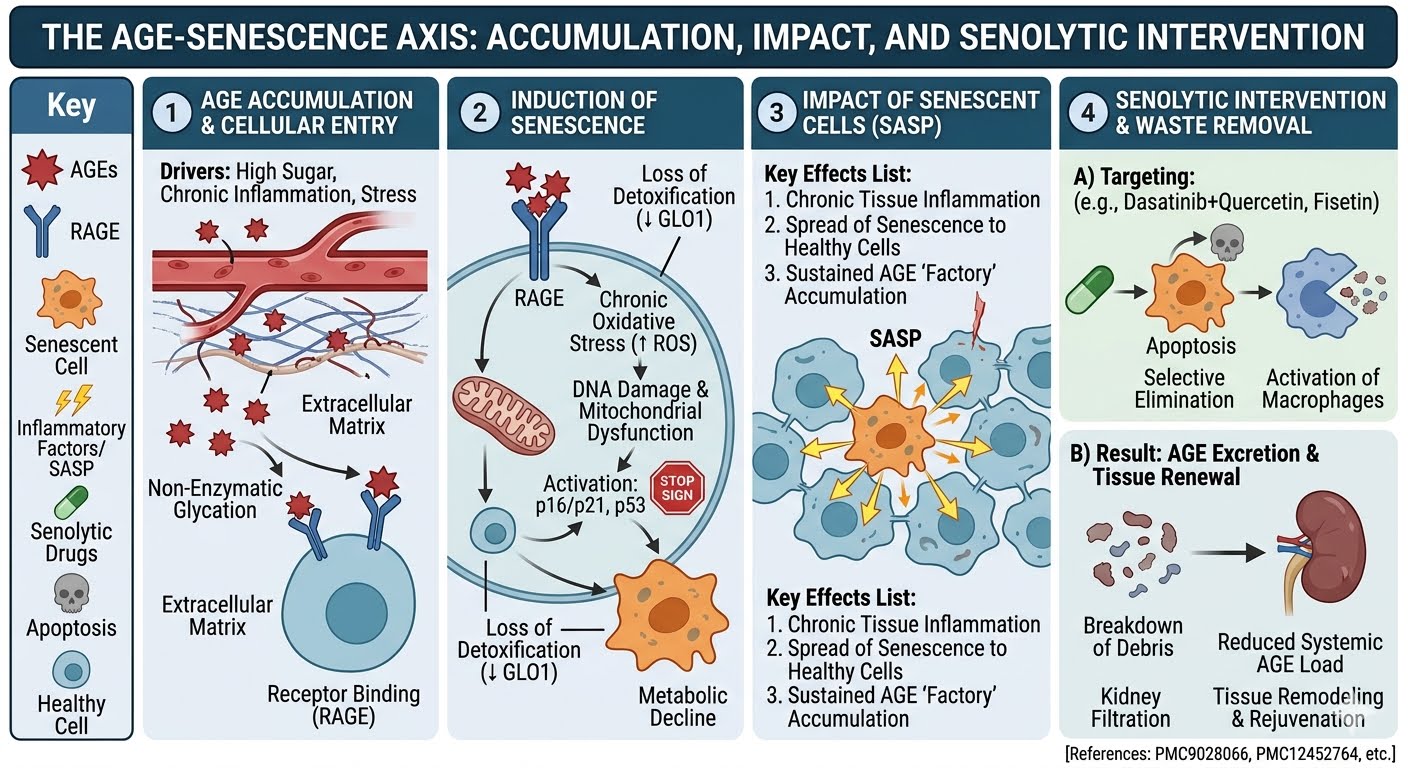
- Ligand Binding & Oxidative Stress: Circulating or structural AGEs bind tightly to the V-domain of RAGE on the cell membrane. This binding activates intracellular NADPH oxidase, triggering a massive, sustained spike in Reactive Oxygen Species (ROS).
- Genotoxic Injury & Arrest: Chronic oxidative stress inflicts severe DNA damage and induces mitochondrial dysfunction. The cell detects this irreparable genetic injury and activates the p53/p21 and p16INK4a tumor-suppressor pathways, permanently halting cell division to prevent malignant transformation.
- The Glycation Trap: Once senescent, the cell develops the Senescence-Associated Secretory Phenotype (SASP), secreting pro-inflammatory cytokines (like IL-6 and TNF-α) [PMC9028066]. Crucially, RAGE activation downregulates Glyoxalase 1 (GLO1), the key enzyme responsible for detoxifying glycation precursors. Deprived of GLO1, the cell becomes a concentrated “factory” that rapidly accumulates more AGEs, while its SASP secretions spread oxidative stress and senescence to healthy neighboring cells.
-
- Direct Removal of “Glycation Factories”: Senolytic cocktails, such as Dasatinib combined with Quercetin (D+Q) or Fisetin, disable the specific pro-survival networks (like Bcl-2 and PI3K/AKT) that senescent cells use to resist death. Eliminating these cells physically extracts the heavily glycated proteins and receptor rafts trapped on their surfaces.
- Immune-Mediated Waste Processing: When senolytics target a senescent cell, phagocytic macrophages are recruited to engulf the cellular debris [PMC5752849]. These macrophages ingest the AGE-loaded membrane fragments and process them inside highly acidic lysosomal compartments, breaking down complex glycated structures into manageable peptide fragments.
- Breaking the Bystander Chain: By destroying the initial wave of senescent cells, senolytics halt the secretion of SASP [PMC9028066]. This stops the paracrine “chain reaction” that would otherwise force healthy, youthfully functioning cells to become senescent and lose their own AGE-detoxifying capabilities.
Furthermore, clearing senescent cells prompts the tissue matrix to shift from an inflammatory state to an active remodeling phase. Fresh, healthy fibroblasts and stem cells populate the cleared space, expressing high levels of GLO1 and producing newly formed, flexible collagen. While senolytics do not directly untangle independent, extracellular collagen cross-links like glucosepane, they effectively erase the cellular reservoirs of glycation, lowering the systemic aging clock of the tissue matrix.
Frank Wilhelmi - Retired/consultant electronic engineer researches and reports practical strategies for optimizing health and fitness into advanced age. “I have a passion for living life to the fullest, and helping others to do the same.” A rapidly growing body of knowledge now enables us to extend our health and fitness decades beyond popular expectations.